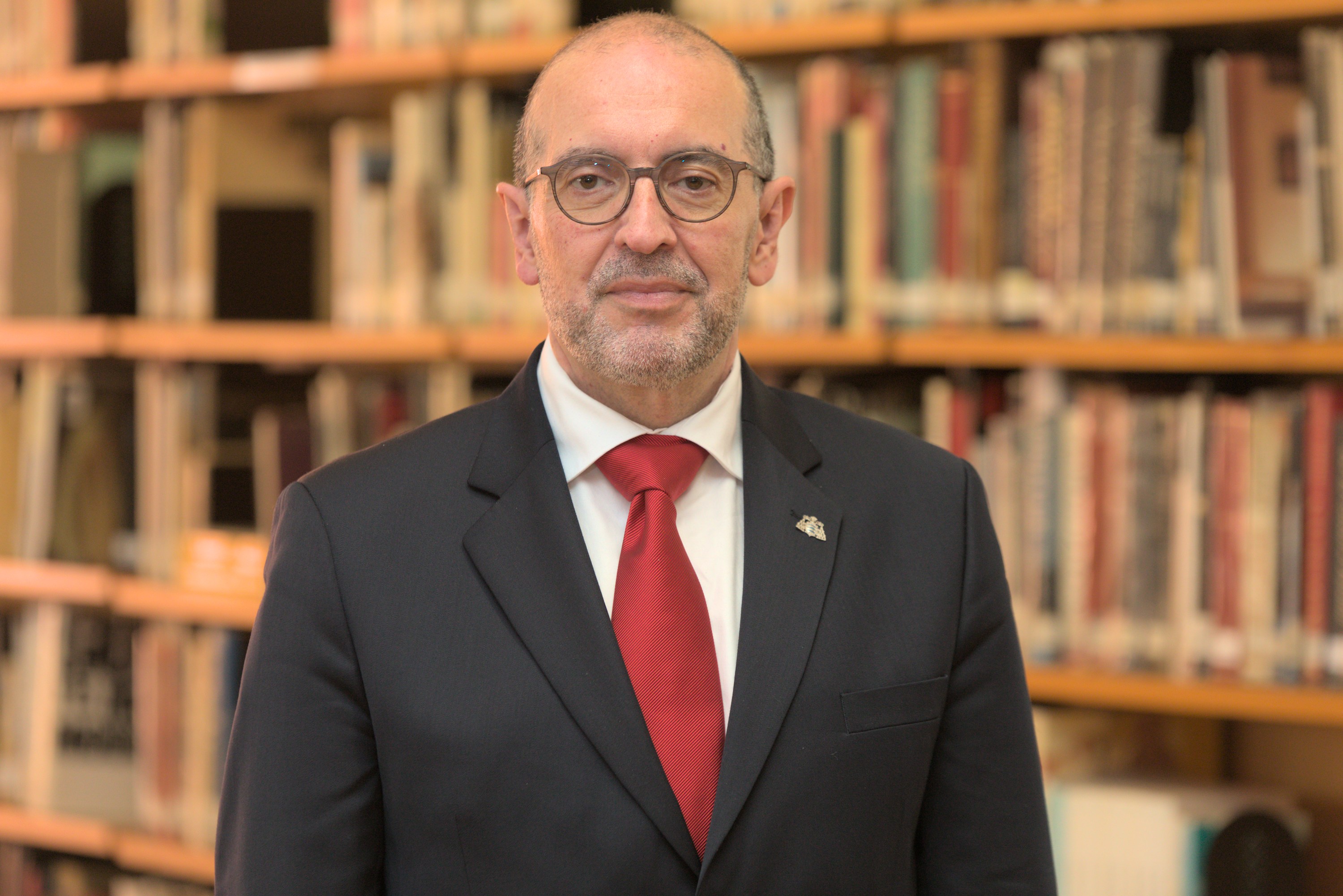
Francisco Martín Miguel
University of Oviedo, Spain
About the keynote speaker
Francisco Martín Miguel is Associate Professor of English Philology at the University of Oviedo, Spain, where he currently serves as Dean of the Faculty of Humanities. He has extensive experience in academic leadership, having directed La Casa de las Lenguas (The House of Languages), the University’s language centre, from 2017 to 2021. His teaching and research focus on English grammar and linguistics, with a particular interest in the theoretical and applied dimensions of English morphology, syntax, and semantics. Over the years, he has been invited to speak at numerous national and international conferences, including those hosted by NOVA University Lisbon (Portugal) and Transilvania University of Brașov (Romania). His scholarly work has appeared in books, edited volumes and peer-reviewed journals, and he has also delivered a TEDx talk on the power of language in communication. In addition, he has contributed to several research projects funded by the Spanish Ministry of Education and by the European Union’s Socrates–Lingua A programme.
Keynote presentation From Words to Worlds: Language, Identity and Emotion
This talk explores the essential role of words and vocabulary in shaping human worldviews and enabling both individual and collective expression. Language is far more than a means of communication; it is the framework through which we interpret reality, give voice to experience and establish our place in the world. The central argument advanced here is that the richer our lexical resources -that is, the broader and deeper our vocabulary-, the greater our capacity to perceive, understand, and engage with diverse realities.
Drawing on contemporary linguistic and cognitive theories, the discussion highlights that every word in our mental lexicon functions simultaneously as a tool and a lens for interpreting our surroundings. Referring to seminal works by theorists such as Sapir, Whorf, and Wittgenstein, the lecture examines how linguistic diversity across cultures gives rise to distinct conceptualisations of the world. Through illustrative examples comparing collocations, ways of saying and forms of expression in English and Spanish, the talk demonstrates how vocabulary both reflects and generates specific worldviews. The presentation reflects on the cognitive processes involved in managing literal and non-literal meaning, denotative and connotative alike, while also addressing the creative and transformative power of words in shaping thought, fostering empathy, and promoting cultural understanding and intellectual growth.
Ultimately, this journey through lexical landscapes reveals that words do not merely reflect reality or convey meaning: they arouse emotion, guide us, give us hope, and help us shape both the external world and our inner one. The power of words extends far beyond denotation; the connotative dimensions and associative networks we activate when using language are the true drivers of its evocative magic. The ability to accurately name, describe and nuance experience is shown to depend on the breadth and depth of one’s lexicon. By enriching our vocabulary, we expand the boundaries of what we can think, feel, and communicate. This talk thus invites reflection on language as humanity’s most vital resource: a dynamic, evolving medium for constructing identities, sharing perspectives and embracing the manifold nature of the world.