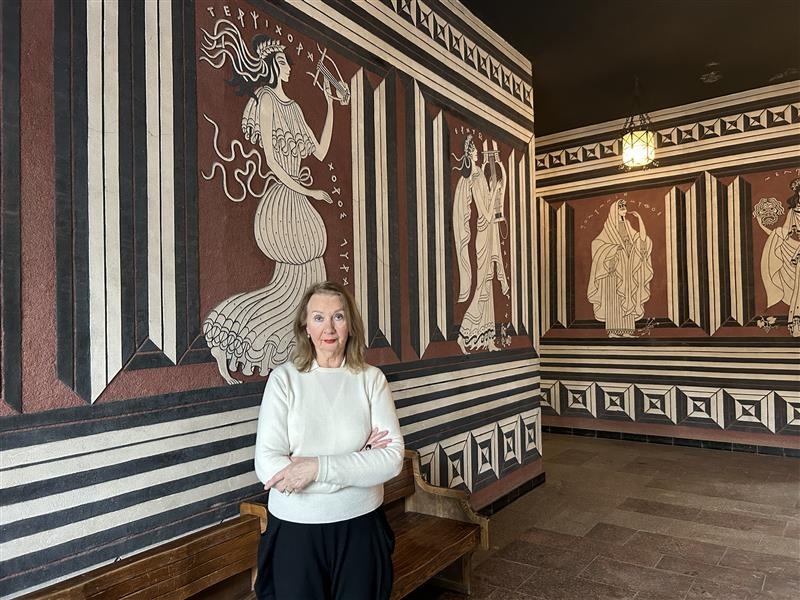
Regina Rudaitytė
Vilnius university
About the keynote speaker
Regina Rudaitytė was (until 2020) Full Professor of English and Comparative Literature at Vilnius University, Lithuania. She holds an MA in English from Vilnius University and an MA in the Novel from the University of East Anglia, UK. She received her Ph.D. in American Literature from Moscow M. Lomonosov University. She was a national representative on the ESSE board. She has published widely on contemporary British fiction, women’s writing, literary translation and is the author of The Metamorphosis of Character in Postmodern Fiction (2000), and An Outline of Contemporary British Fiction (2006). She edited the volumes Postmodernism and After. Visions and Revisions (Cambridge Scholars Publishing, 2008) and Literature in Society (Cambridge Scholars Publishing, 2012),History, Memory and Nostalgia in Literature and Culture (Cambridge Scholars Publishing, 2018).
She was the editor-in-chief of the scholarly literary journal “Literatūra” (Vilnius University Press).
Keynote presentation The World as a Structured Play of Shapes, Forms and Colours
The Greek word morphology, although generally referring to the study of shape and form, is a concept entailing slightly different connotations in various spheres of human thought.
In Linguistics, morphology is the study of the structure and content of word forms, the identification, analysis and description of the structure of a given language’s morphemes and other linguistic units.
In Literature and Arts, it can denote the study of the structure of narratives, of shapes, forms and colors of artifacts.
In his essay Morphologie (1790), Goethe suggested that two seemingly disparate fields of inquiry, natural science and poetry, could be related. And, according to Goethe, as with a plant, the creative forces of life must be guided, trained, and restricted, so that in place of something wild and ungainly can stand a balanced structure which achieves, in both organic nature and in the work of art, its full intensification in beauty.
In my paper, I will try to trace the workings of the concept of morphology in Literature and Arts, and show its function and meaning, highlighting the validity and significance of structure, form, shape and color based on modern theories, particularly that of structuralism, Oscar Wilde’s aesthetic theory, James Joyce’s innovative text, and some modernist art trends that have produced the most conspicuous manifestations of structure, forms and colors.