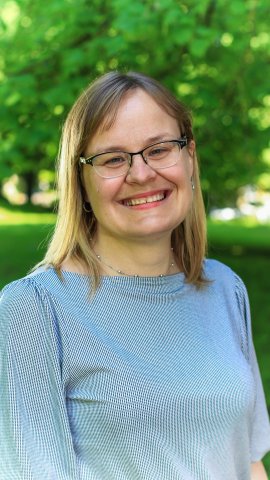
Kaidi Lõo
University of Tartu
About the keynote speaker
Kaidi Lõo is a Research Fellow in Psycholinguistics at the Institute of Estonian and General Linguistics, University of Tartu, Estonia. She completed her Master’s degree at the University of Tübingen, Germany, and her PhD at the University of Alberta, Canada. Her current research project, “Crossing boundaries in morphological processing: the effect of inflectional paradigm size”, funded by the Estonian Research Council, investigates language processing across modalities, including spoken and written language, with a focus is on phonetic and eye-tracking methods to understand how people produce and comprehend words in real time.
Keynote presentation Introducing EALD: what 500 Estonian listeners can tell us about spoken word recognition
In this talk, I introduce the Estonian Auditory Lexical Decision Database (EALD), a new large-scale psycholinguistic resource for studying how spoken words are recognized in a morphologically rich language. Over 500 native Estonian speakers (aged 18–72) took part in an online listening experiment in which they decided whether what they heard was a real Estonian word or a made-up one. The database contains responses to 8,800 real words and 8,800 pseudowords.
While most existing databases focus on Indo-European languages, EALD turns to Estonian, a Finno-Ugric language where a single word can appear in a large number of inflected forms (e.g., maja “house”: majas, majast, majale, etc.). Estonian is therefore well suited for examining how complex word forms are processed in real time.
The first analyses indicate a clear pattern in the data. Morphological similarity helps: words with many morphological neighbours are recognized faster and more accurately, especially when they are frequent. Phonological similarity, by contrast, hurts: words with many phonological neighbours are recognized more slowly and with more errors (e.g., kass “cat”: tass, kast, kaas). As for individual differences, older participants are more accurate, but surprisingly also faster.
Together, these findings show that not all listeners and similarities are equal and morphology and that sound structure play different roles in spoken word recognition. EALD opens a new window onto spoken word recognition beyond well-studied languages and offers insights into how complex word forms are processed as they unfold in time.